


Life is not a football game
And an audience is not a tribal fanbase.


Brilliant post from the wise Om Malik:
Federal agents shot an American citizen, and it was caught on video. It is the sickening outcome of virulent tribalism sweeping our world, enabled by the internet. We have forgotten that life is not a football game. Pick your team. Defend your side. Ignore evidence if it contradicts your tribe.
We think democracy is the flag, the ability to vote, or words in the Constitution. It is not. Democracy is an idea, an ideal, an agreement. Once you decide evidence does not matter if it hurts your team, you have already lost the thing you think you are defending. We are not seeing what is happening to us.
One of the bits I do when training or lecturing about online communities is this:
The wonderful thing about the internet is that it allows you to find people like yourself.
The terrible thing about the internet is that it allows you to find people like yourself.
The way that the tech companies have used algorithms makes the latter more likely than the former. But we, in journalism, are also guilty of playing the polarisation game, and stacking the balance towards the negative side of online community.
The polarisation trap
As the industry shifts back to community building as the heart of audience work, we really need to consider how we do it in a way that doesn't increase tribalism and polarisation. Why? Well, there are both social arguments, which Om outlined above, but also business ones.
From the equally wise Greg Piechota:
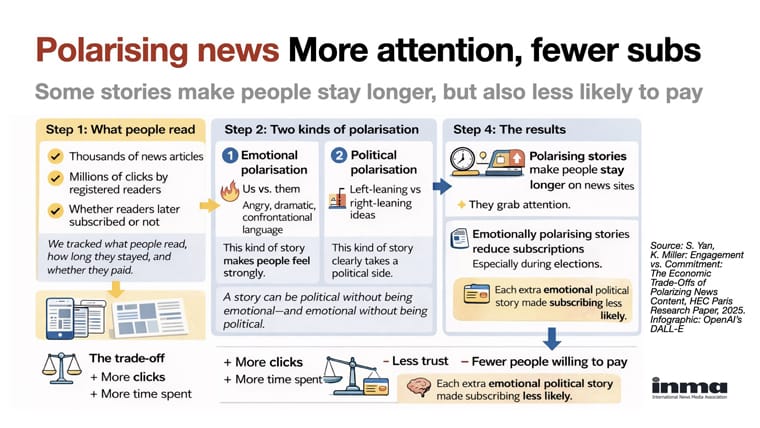
Value-destroying content: Professor Shunyao Yan of Santa Clara University and Professor Klaus Miller of HEC Paris analysed data from “a major European news Web site” (62,000+ articles, 40 weeks of user-level clickstreams and conversions), used LLMs to score content, and isolated causal effects.
They found that polarising, and especially emotionally charged, “us-vs-them” content, increased time spent but reduced the likelihood of subscribing, particularly during politically charged moments like elections.
Another truism of audience work: engagement on its own is not a unalloyed good. The type and quality of that engagement matters.
There's a useful infographic in Greg's piece:
Food for both strategic and social thought…


