


The four pillars of modern media
The way people get information has changed. And we're not adapting fast enough.

Yesterday, I was a guest on a recording of the Stop the Press! podcast. (If you read yesterday’s post, you know I very much have a face for podcasting right now.) They invited me on to expand and defend my thesis that journalism isn’t dying. in an episode due for release early next week.
While I was deep into expounding my theory of how journalism is changing, one of the hosts put it to me that maybe this is a process without end; that the ongoing change in tech means that journalism will have to keep evolving.
He was absolutely bang on.
Short of some unforeseen factor hitting the brakes on tech innovation, we are In for a long, long ride of disruption. (Mind you, the growing shortage of tech components caused by the AI boom could be exactly that sort of brake…)
But we’re not always very good at spotting how much technology has already changed journalism. There’s an interesting streak of small “c” conservatism in journalism, a deep nostalgic attachment to the formats of the past. I’m prone to it. I had a deep burst of nostalgia for my old magazine days when I got my hands on the latest issue of XCity, the magazine produced by our MA Magazine Journalism students.
But nostalgia is not a business model, and we need to look at the reality of how people get news and information now. And, online, that’s changed. Even the web is a somewhat nostalgic product now.
The true face of media distribution in 2026
A recent issue of Casey Newton’s Platformer newsletter [£] made an offhand remark that I think both sums up how the modern media word operates — and which I know many media businesses haven’t completely assimilated as an idea yet:
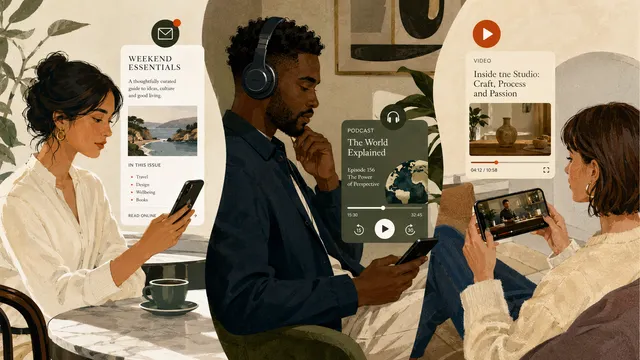
The mass audience has now moved fully to video; the personal audience now lives in the group chat. Professionals are getting their information from newsletters and podcasts.
The information landscape has changed almost completely from even a decade ago. The social platforms function very differently, and how people choose to get their information has gone through a slow revolution. The four points that dominate today’s media ecosystem are:
- Video-based social media
- Closed chat communities
- Newsletters
- Podcasts
So, what of the web? It’s still there. We still visit it. But, increasingly, we only do so when prompted by something else to do so — or when a specific need (in SEO terms, an “intent”) drives us there.
The new shape of editorial products
This is important to grasp because so many media businesses I work with still see the website as the main and default part of the business, and these other elements as, essentially, promotional tools. But they’re not. They’re products within your portfolio of publications; they’re editorial products in their own right.
To use a personal example, I mainly interact with Prospect and the New Statesman through their podcasts. I occasionally buy an issue, or catch something on the web, due to my interest being piqued by the podcast. But for me, personally, their podcasts are their main product. And that’s good news – because that’s a direct relationship, unmediated by AI or SEO or social algorithms. Well, good news as long as they can make money off my listening, of course…
Many of you reading this post now will be doing so in your inbox, even though OM&HB is also a website that’s existed for 23 years. With a few exceptions, it’s an editorial product that is more consumed as a newsletter than as a website.
Persuading people that change is here
One of my personal failures over the last 18 months has been failing to convince my colleges and students at City St George’s about the critical importance of newsletters to modern journalism. We’ve got it on podcasting; we have an entire Masters pathway devoted to it. We’re pretty close to being there on social video. But we don't, yet, have a module, or a pathway, or even consistent teaching around newsletters. So, we need to take the form much more seriously than we do, and I occasionally feel like I’m screaming into the void on this one. Only last summer, I was told that newsletters were an “emerging” form.
Reader, I did not take that well.
But here, all we’re seeing is not some failing of my excellent colleagues, but an accurate reflection of the industry’s mixed understanding of where we are now – and a damning critique of my own persuasive abilities. And something I suspect that addressing will be on my workload allocation for next year…
This challenge is faced right across the industry. The media world has changed around us. If you don’t understand and believe the paragraph from Casey above, you’re not ready for that.
From content strategy to product strategy
I used to run a content strategy course, but haven't done so for a few years. I need to resurrect it, but also almost entirely rebuild it, with more of a focus on editorial product thinking. It might even need a new name. We're already running a version of what this should be for our undergraduate students, in their second year. And they produced some truly excellent products this term. The module is going into the labs for expansion and upgrade to be a bigger year three module in the 27/28 academic year.
But media businesses that want to survive can't wait for our grads to come save them. We need to reset our mindsets. The web, and podcasts, and newsletter and video are co-equal tools we can use to get our journalism in front of our readers. Which we choose, and how we use it, will be determined by a mix of audience need, the nature of the story, and the business model of the title.
Ready?
About those video figures
There is one other paragraph from that Platformer newsletter that I want to highlight, but for entirely different reasons:
And the bigger picture is that text-based social networking is a rounding error compared to video. Telecom provider Ericsson estimated that by the end of 2025, 76 percent of all mobile data traffic was video.
Aargh. I’ve seen variations of this figure for years, and yes, the percentage keeps ticking up. But it needs context; otherwise it’s meaningless. A text-only post to a social network is usually only a few kilobytes in size, and certainly less than 1 MB. Add a photo, and you’re looking at a few megabytes, up to maybe 15 MB.
A video post on any network? It starts at 20 MB, and can go up from there to the 100s of megabytes. So yes, video posts might account for 76% of all mobile data traffic — but each video can be up to 1000 times the size of a text post. This is not a like-for-like comparison. This is not to argue that video isn’t the dominant medium — it is — but that this figure is meaningless without some form of context and explanation. It doesn’t imply that 75% of all social media activity is on video.


