


Cuttings: Getting back with your X
A weekly round-up of links worth reading for people in the media racket


Is it time to return to X?
In certain parts of the internet, there has been growing talk of a return to X. The obvious competitors – Bluesky, Threads and Mastodon – aren't delivering for many people. Casey Newton has a good reason for going back:
And so, in the coming days, I plan to resume posting on X. I am doing so not because I think it’s any better — it isn’t — but because I have exhausted all of the alternatives. I continue to believe that anyone who can avoid posting on X should. But my calculus about the tradeoffs involved for my own work has shifted: as the stakes of the AI conversation have risen, boycotting X over my disagreements with management has grown both more costly and less effective.
If you're reporting on AI, it's hard to avoid X. It's where AI people talk to each other. Some people's reasons I find harder to get my head around:
The only network that compares to X, size-wise, is Threads — but Threads’s algorithm is weirder than X’s now, and the content I see there is relatively boring. My Threads timeline is full of engagement bait without being engaging. And if you want to judge a platform by its owner, “I’m grossed out and/or appalled by Elon Musk so I’m going to Mark Zuckerberg’s joint” isn’t a way to avoid being grossed out and/or appalled by the owner. Bluesky and Mastodon are too small for most people to care about — and, worse, they are the networks where politics are, in my experience, unavoidable.
Maybe John Gruber – the author of the above – has curated his feed better than me, but that is absolutely not my experience when I return to X. It's actively pushing the most polarising politics at me. It keeps recommending posts by Graham Linehan to me, for example, a man I have never followed, even when he was a beloved presence on Twitter. (That feels like a long time ago now.)
But Mathew Ingram has a long and journalistically relevant take on this issue, which is well worth your time:
Casey put his finger on the main problem: if you are interested in the growth of artificial intelligence (or whatever Trump is forcing people to call it now) and the risks and potential benefits and what they say about the nature of consciousness — which I very much am — then Bluesky and Threads and Mastodon are just not going to cut it. All of the leaders of this multi-trillion-dollar industry in the making, whether it’s Sam Altman of OpenAI or Dario Amodei and Jack Clark of Anthropic, or some of the leading scientists behind Google’s DeepMind, are posting on Twitter. Not only that, but some of the industry’s most prominent skeptics and critics are there as well. And they aren’t just posting the occasional quip now and then — many of them are posting long and thoughtful comments about what is happening as it happens, whether it’s the Hugging Face hack or the recent news that some of Anthropic’s new models might be able to replicate themselves using any internet-connected device rather than a data centre.
 Mathew Ingram
Let the past die. Kill it, if you have to.
Well over 18 months ago, City St George's decided that it was time for a change that's been batted around for over a decade: the MA Newspaper Journalism needed to be rethough.
Three weeks ago, our first cohort of MA Journalism students arrived, the first to go through a new, expanded course that incorporates the best of MA Newspaper, MA Interactive and MA Data Journalism.
This week? Press Gazette publishes a story about it...
 Phin Hubbard
One of the story’s co-authors is from the final cohort of the MA Newspaper degree. I was still supervising his final project only two months ago.
Betteridge's Law applies
A good sceptical take on how some people are pitching AI agents:
These AI assistants are like putting an intern in charge of your life. Do you really want to middle-manage all of this, focus on quality control and all, rather than just do the thing yourself? The doing, that friction that it brings, that is the life, that is the work!

Mercury rising in Derby
George Allen spent ten years at his hometown paper the Derby Telegraph/Derbyshire Live, rising to the role of head of content.
George […] left the title last month after taking advantage of a voluntary redundancy scheme which saw around 50 journalists leave the publisher.
Now he has set up the Derby Mercury, a new subscription-based website on Substack which promises three ‘long reads’ about the East Midlands city each week.
Another town gets a deep reads site on the Manchester Mill model.
Well, this isn't going to worry media lawyers at all…
Thomas Baekdal on a massive leak of data about the public in Denmark, thanks to a company with access to it's terrible security:
Through journalistic work, Danmark Radio (DR) managed to uncover which company it is, but in respect of the investigation, also decided to withhold the information.
And then?
So… what do you think happened? Yep… Perplexity immediately identified the company and provided me with a link to their website, showing it to be under construction.
This… changes the dynamic of anonymity in news, doesn't it?
 Thomas Baekdal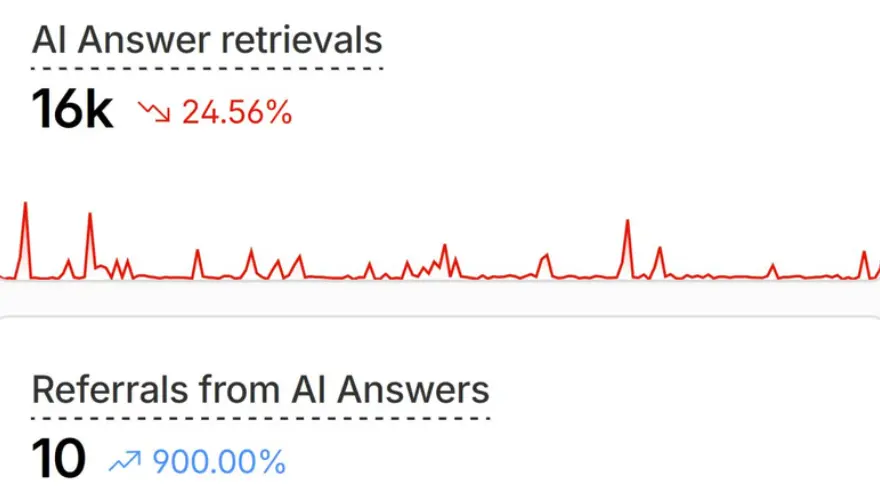
Have a great weekend, folks. See you on Monday…


