Cuttings: AI in court, and defining podcasts
Google's AI is ruled liable in Germany, media leaders try to define podcasting – and I'm on a podcast (again)


A German court rules that Google is liable for the content of AI overviews
This came up in the discussions at OphCon last week, and I think it's absolutely worth paying attention to. One German court has decided that Google “creates“ AI overviews, so is liable for the content within them:
A court in the Bavarian capital of Munich on Friday ruled that search engine operator Google can be held directly liable for incorrect answers generated by its "AI overview" feature.
As soon as you see that question, you realise how much it makes sense. An AI overview is literally a generative answer. It has been created. And if it's something Google has created, rather than just a link to other people's material, shouldn't Google be held liable like any other publisher that creates their own content?
Because the AI summarizes results in its own words, evaluates their content, and presents them in a structured format, the judges ruled that Google creates entirely new, independent statements that go beyond mere links.
The court also rejected Google's line of defense, namely, that users could verify the sources themselves via the links and knew anyway that "AI-generated information should not be trusted blindly."
Judges said the AI overview constituted "a self-contained statement with independently comprehensible content." The reader was given no indication of any unreliability in the content, the court found.
Of course, Google will appeal, so this one has a long distance to run. But it could set a very interesting precedent that could change how with think about liability and AI. 🍿
Quick Links
- 🚪A UK government department quits X. The drift is slower than I expected, but it is real.
- 🦋 Meanwhile, Russia's propagandists are targeting Bluesky.
- 🦣 Mastodon is borrowing Bluesky's Starter Pack idea and reincarnating it as Collections.
- ✉️ You can also let people who aren't Mastodon users subscribe to your posts via email. Yup, it's a form of newsletter. They get everywhere. You can see the signup form on my Mastodon profile.
What is a podcast?
Well, to me, as an old school kinda guy, the answer to “what is a podcast?” is “an audio file delivered to a device via an enclosure in an RSS feed”.
But apparently, that technical definition no longer holds. The Media Leader asked six “experts” to define the term. And the answers are… interesting.
Dan Box, The Times and The Sunday Times: “What defines a podcast is its informality and authenticity. A good podcast should feel like the conversation with your friends in the pub, that’s so engaging you just want to lean into it. That’s true whatever the format – audio, video, social, live show or all of those at once.
The general consensus seems to be that we're shifting from a technical definition, to a content style one. My problem with that, is that once you take that definition, and apply it to something that's primarily delivered via video, you've just reinvented the talk show…
We're in a kind of liminal point with podcasting, but if we assume that all podcasts are a video-driven medium, we lose its primary advantage: it's a secondary medium, which you can consume while doing something else. In my case it's usually showering, commuting, cooking or washing up.
I'd like to think that the original definition might hold up. But then look at how the word “blog” has drifted from being the abbreviation for “weblog”, which is a type of website, to the name for a short opinion piece.
Listen to the future of journalism
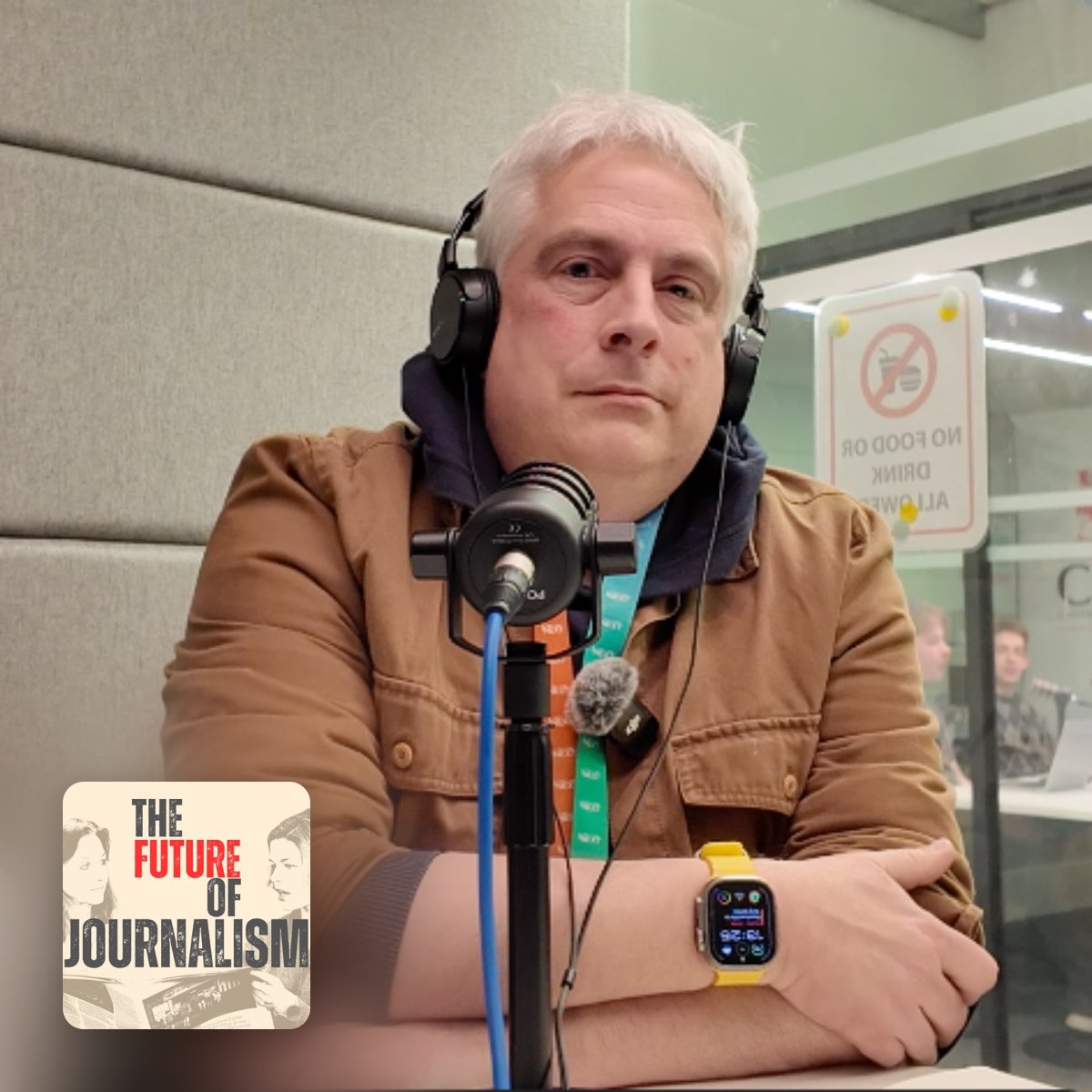
Talking of podcasts, two of this year's talented MA Podcasting cohort, Jackie Imas and Julie Béguin, have just launched a new podcast called, with startling clarity, The Future of Journalism.
They've got a trailer you can listen to here:
Rather flatteringly, they invited me on as the first guest on the podcast, which you can listen to here:

Perfect weekend listening!
See you all next week.