I have a confession. And a boast. Boast first, then confession. I’ve been teaching and consulting in SEO for the past 14 years. I’ve left newsrooms for the airport after three days with a team, their search traffic already well up. Graphs of increasing visibility and click-throughs in a declining market have delighted clients.
While there are people out there who are better or more knowledgeable about technical SEO, I have no false modesty about my skill in getting journalists to do better SEO, and seeing their work get the readers it deserves. I’m good at editorial SEO change management.
And now the confession: I’m finding it very challenging to care about it.
Last week, I drove along the Brighton seafront, on my way to meet my family for the Ocean Film Festival. I saw the big hoardings up for BrightonSEO. In the past, that has often triggered FOMO – the sense that I really should be there, catching up with the latest news. But this year, I just shrugged, parked and enjoyed sushi and some movies with my wife and daughters.
Equally, the News and Editorial SEO Summit (NESS) is running at the time of writing, but I’m, well, only abstractly interested. I’m sure the presentations are great. Some fantastic people of my acquaintance – like Nick Petrie – are speaking.
But my interest in SEO as a whole is waning in direct proportion to Google’s declining interest in search.
The opposite of love isn’t hate; it’s indifference
Before you jump to conclusions, it’s not because I buy into the “zero click” search future. There will always be some search traffic, either directly or as a reduced volume from LLM responses. This is not an “SEO is dead” piece. SEO is very much alive and well, and I was giving our new MA Journalism students a firm foundation in it just yesterday. In some fields (your money or your life (YMYL) fields, in SEO parlance), it may remain the dominant audience-acquisition tool.
But something has changed in the past two years. And you know why. It’s two letters long. Yes, those two.
I still read the SEO blogs, and follow the key players in editorial SEO, but the moves are clearly small, incremental. Google’s focus isn’t on improving (or even evolving) the existing search experience. The focus is all on Gemini and the AI overviews. And we know that the returns from our content appearing in AI results are a tiny fraction of what we get from conventional search.
Have you tried my snake oil? It’s called GEO!
Yes, there’s an attempted pivot going on towards GEO – generative engine optimisation – but that’s still very much snake oil right now. Models are changing at such a pace that what works and what doesn’t is evolving faster than you can implement the changes. It’s certainly moving faster than consultants can evolve their decks.
Conversely, SEO is moving more slowly than ever. The key principles have settled down after the waves of change we saw around search intent, entities and E-E-A-T. Just as I don’t track every tiny algorithm shift on the social platforms, only the general direction of travel, I no longer feel it’s necessary to track SEO day-to-day.
In the end, my apathy exists because the days of SEO as an independent area of focus are over. I don’t believe that it’s possible to build a business just on search traffic any more. Even if it is, it’s profoundly unwise to do so. Too many businesses have died when the single platform they relied on changed the game around them.
SEO’s importance has been on the wane for a while, as our business models shift. The AI changes are only accelerating this. But a decline in importance is not the same as irrelevance.
Just another tool in the toolbox
SEO is – and will remain – another tool in our audience toolbox. Still an important one, mind. But a tool. And like most tools, you’ll do far better work with it if you know how to use it in conjunction with the other tools we have in that toolbox. You need to know how to use, when to use and how to deploy it with the most impact. And you also need to know how it fits in with other tools.
If you look closely at this year’s NESS schedule, day three isn’t actually about SEO at all. It’s about other audience relationships tools. That’s the future for that event – it’ll have to evolve into something like NEAS: the news and editorial audience summit. As for BrightonSEO? Unless they’re smart, and find a good pivot, it’ll become BrightonGEO, before disappearing in a cloud of hallucinated evidence.
And for me? Well, now I’m settling into my expanded role at City St George’s, I’m looking at what I do with my remaining time for consulting and training. For one, I’d like to work with slightly fewer clients, but more intensely. But I’m also going to reshape my courses when I start offering them again. And, as part of that, I think the days of a “pure” SEO course are numbered. Anything I do will have to be as much about what you do with the traffic once you have it as about acquiring it.
So, perhaps this is less apathy than a necessary rebalancing of SEO’s role in today’s increasingly audience-centric newsroom.
Further reading
This is an interesting round-up of how newsroom leaders are seeing the shift in the relevance of SEO:
 Gretel Kahn
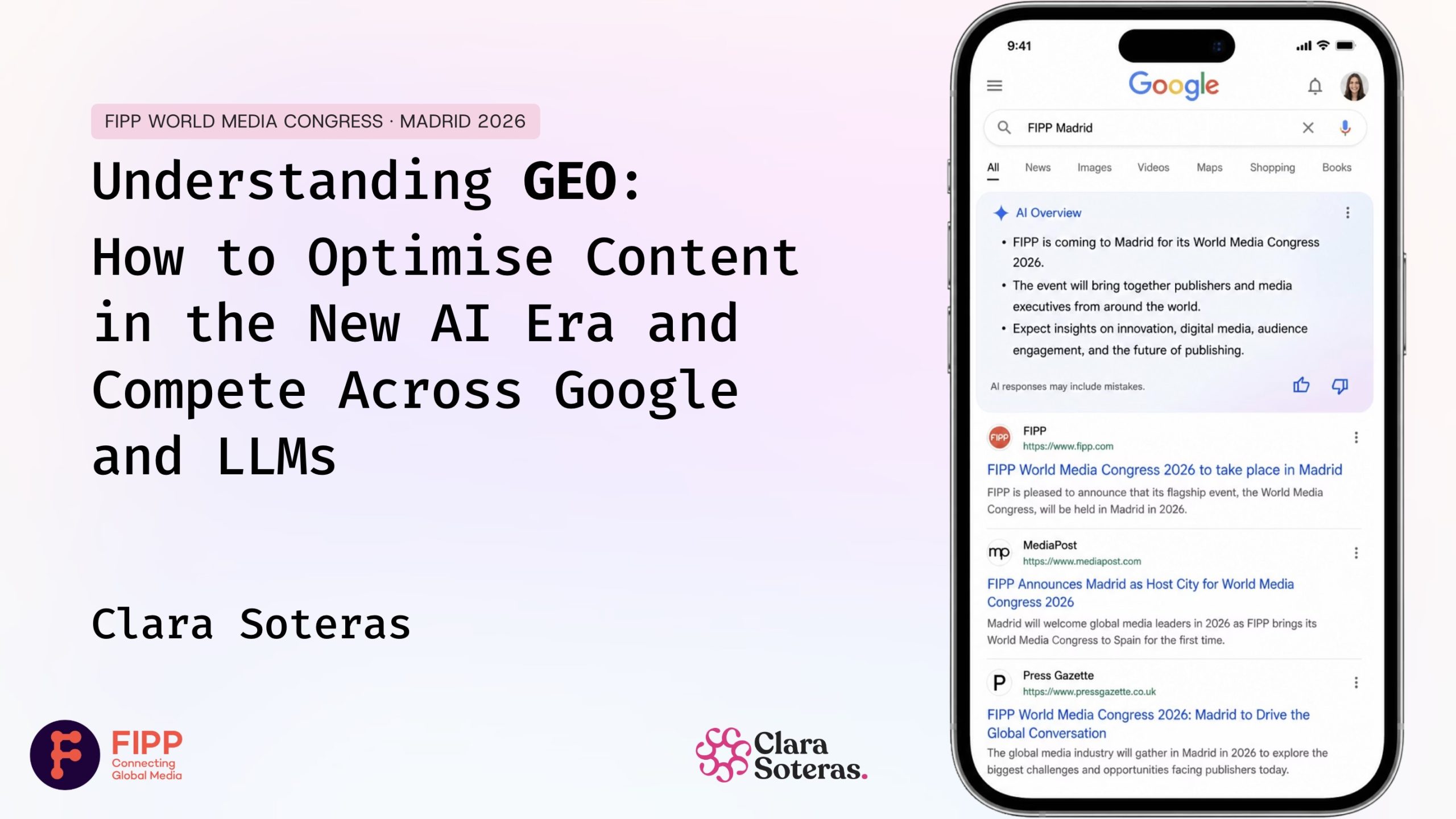
This presentation from Clara Soteras has come the closest to persuading me that GEO is not snake oil than anything has so far. She largely does it by the sleight of hand of defining GEO as "good SEO that also works for LLMs", though.
 Clara Soteras