

Navigating the shifting sands of audience strategy
A round-up of stories to inform your work - and a pledge to stay reverse centaur-free. Really.

One thing I do with my audience strategy students every year is to devote the first part of our three hour workshop to sharing and discussing stories that impact audience work in and around podcasting and journalism. This helps both embed the teaching in the reality of practice, but also trains the students to keep on top of the shifting online environment we're playing in.
On weeks 2 to 10, an ever-rotating group of students lead this. On week 1, I start the ball rolling by presenting a selection of what's caught my eye over the week.
I suspect many of you will find this as interesting and useful as many of them did.
The PA pivots to vertical video
If you're still sceptical of “pivot to video” after the mid-2000s Facebook video mess, then you need to pay attention to this:
 Freddy Mayhew
The PA is building a stream of social media-ready vertical video footage for them to construct TikToks / Reels / Shorts from. Why? Because there's significant chunks of audiences who want it. It's one of two things:
- Their main form of news consumption
- Their front end on the internet, through which they discover other things.
The PA knows this. Does your business?
Don't you take that tone with me
This was the trigger for an interesting discussion on social media tone:
View on Threads
Does this piece of satire work for Channel 4? I think so, and so did the students. It's within the voice of what we expect from the broadcaster.
Would it work for Channel 4 News? Probably not. Would it work for the BBC? Absolutely not. Finding your social media tone is a critical point of making it work for your publication. But shifting tones is not an easy skill to master.
Top of the Social Media Pops

Hello, pop pickers. (Throughly confusing anyone who is under the age of 40 or not British there. Sorry, not sorry.)
OFCOM have released the annual Online Nation report, and the top five social platforms in the UK by visitors are…
- YouTube
- Facebook/Messenger
- TikTok
I think it's fair to say that there was some surprise about that, and in particular how used Facebook still is, even though it's largely dropped off the radar of some chunks of the population. The other, of course, is the sheer strength of Reddit. Now, the smart social and audience teams have been on top of this for a while, but it's nice to see the evidence backing up their intuition.
However, there's some nuance in the details, which I hope to come back to in a later post (no promises, mind), which makes taking time to check out the whole thing worthwhile.
 Michael Savage
Are you a centaur – or a reverse centaur?
I don't read Cory Doctorow as much as I should, but I caught a post from him earlier in the week that nicely encapsulated something that had been in my head for some time. He's the man who coined the term “enshittification”, so he knows how to turn some fairly abstract tech idea into something that we can easily discuss. Here he's talking about the interaction of AI and professionals (which includes journalists):
Sure, there are instances in which professionals may choose to make use of some AI tools, and I'm happy to stipulate that when a skilled professional chooses to use AI as an adjunct to their work, it might go well. This is in keeping with my theory that to the extent that AI is useful, it's when its user is a centaur (a person assisted by technology), but that employers dream of making AI's users into reverse centaurs (machines who are assisted by people).
What the metaphor here? A centaur is mainly human, but a human whose capabilities are enhanced by the horse body. A reverse centaur is a horse head on a human being, which doesn't make the horse bit or the human bit any better.
Let me illustrate that for you, via the medium of AI:
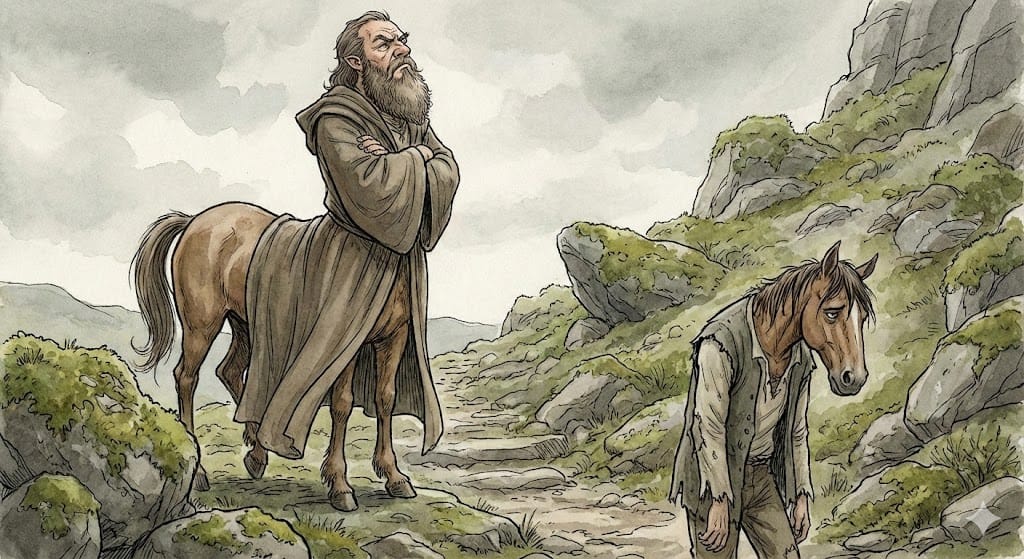
In journalism terms, if you're letting AI do the writing, and you're editing it, you're the chap on the right. If you're using AI carefully to improve the quality of your work, or to help you find more sources or information, or to interrogate reports more deeply, you're a centaur.
One Man & His Blog remains proudly human-written, with occasional AI research and illustration assistance. And if you're going the other way, I think you're setting yourself up for some serious problems.
Reverse Centaur Podcasting
The great thing about podcasting is the relationships you build, parasocially, with the regular voices in your ears, right? Well, one startup is destruction testing that theory by going in completely the opposite direction:
Already, there are at least 175,000 AI-generated podcast episodes available on platforms like Spotify—thanks to startup Inception Point AI. The company, with just eight employees, is churning out a whopping 3,000 AI-generated podcast episodes a week.
But is anyone actually listening to this content? You might be surprised. Inception Point AI’s podcasting network, Quiet Please, has generated 12 million lifetime episode downloads and 400,000 subscribers.
I do find the idea of people listening to AI-generated audio, with minimal human input, rather chilling. But we're cruising towards a reality in which audiences bifurcate, with a significant chunk happy with essentially disposable AI slop, and a smaller, but more demanding, audience group who want and demand human content.
But then, loyal audiences have always been smaller, more demanding – and more profitable. Any publication needs to find ways of minimise its exposure to income from casual audiences, who may well be bled off into AI slop, and deepen its relationship with that core audience, who value the human in your publication.
Case in point, as one student pointed out: The Rest is History Festival
The ones I missed
Other stories that would have been worth talking about that slipped my mind:
Goalhanger's hitting goals
Goalhanger's podcasts now have over ¼ of a million paying subscribers, totalling around £15m per year. (It's worth noting that nearly half of those subscribers are for one show: The Rest is History. Y'know. The one with the festival from a paragraph back.
When I first wrote about paid podcast models seven years ago, it felt like something that B2B publishers should try. In much less than a decade, it's swiftly mutated from an idea one group of podcasts should try, to a fundamental new business model for all podcasting.
Catching up on creators
Guilty admission: I've had the Reuters Institute annual predictions and trends in my in-box since before it was released. But a feral mass of marking lay between me and it, and I've only just tamed it. But I think the idea that publishers are now piling into creator-like content to be worth some analysis. (How long has "and the creator economy” been part of the tagline of this blog? Literally years.)
This I will commit to coming back to.
 Sarah Scire
What is a podcast?
When Saturday Night Live alum Pete Davidson heads into his garage, turns on some cameras, and starts talking to his friends, you might think he’s fixing his car or trying to find a hammer. Not in Davidson’s case: He’s filming a podcast for Netflix, which will feature candid, no-holds-barred conversations.
The Pete Davidson Show, a new video podcast, will be exclusively available on Netflix starting Friday, Jan. 30 at 12:01 a.m. PST with episodes dropping every week.
So:
- It's video
- It's on the Netflix app
- It's not available anywhere else
This is not a podcast. It is, if anything, a cheapo chat show, which is not a new format. They were on TV when I was a kid in the 80s… There's a dangerous semantic drift in progress where “podcast” shifts from meaning an audio file delivered via RSS to an app, to an online chat show. If we indulge that shift, we're going to muddle audience understanding of podcasts even further.


