

TikTok is coming for your talent
But it might just give you an audience in return…

There are no more terrible words for a journalist and compulsive event blogger to hear than “off the record”. It is manifestly worse than “Chatham House rule”. But those were the exact words said by TikTok staff to a room full of journalists, creator journalists — and those aspiring to be.
Fair enough, though. I wasn't at TikTok News's Next Generation event to report on it. I was there to gather information for my students – and make sure I knew how to guide them accurately towards this growing field of journalism. But I think I can get away with some meta-commentary about the event, without breaking the “off the record” rule, and making myself persona non grata with the news team at TikTok UK.
And that's what I'll do, after these anodyne and non-rule breaking photos from the event:
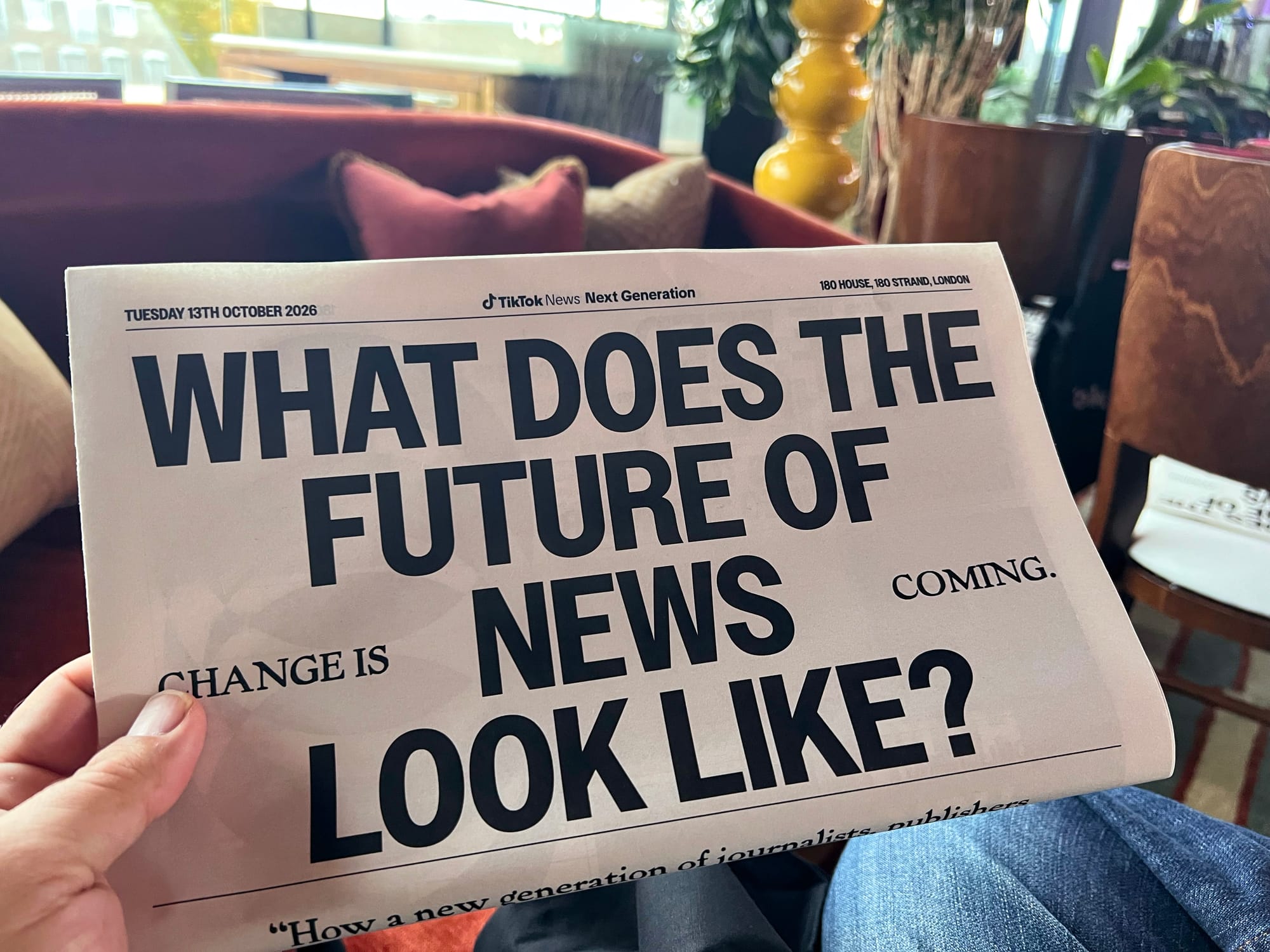



Record shots of an off-the-record event
TikTok ❤️ Journalism (for now)
First of all, the existence of the event is interesting in its own right. It isn't really a surprise that TikTok has a news partnerships-type team. Facebook, Twitter (as was) and even Reddit did back in the day, although most have gone now. TikTok, however, has a unique problem that the other sites didn't: a reputation as a site where people dance. And I've been to parties for journalists, and believe you me, you don't want to see most of them dancing.
If TikTok is to cement its role as the front door to culture for a good swathe of the population, it needs to move beyond that image in the public consciousness, as the number of times the “dancing” problem was mentioned makes plain. The platform needs news in the mix. And as we've heard in the most recent Reuters Digital News Report and at the Future of Media Technology conference (in a panel I've yet to write up), the creator journalist is becoming a significant force in news.
ByteDance clearly wants to nurture the next generation of this talent. Should we accept this invitation? Yes. Concerns about the ownership of the platform aside, the big audience rule applies: fish where the fish swim. And for an ever-growing part of the population, TikTok is where they swim.
Reassuringly, nothing the assembled panels of experts and working creator journalists said was new to me - or varied significantly from what I've been teaching for some years. There was, perhaps, some difference in emphasis. I've been talking about the need for a three second hook in social video for the past decade - but some suggested that it was tightening towards two seconds or even less. Interesting - and challenging.
Equally, the fact that a creator's visible body of work probably only represents a fraction of their actual work is something I need to surface more in my teaching. That's true in two ways: successful creators generally shoot more videos than they publish. Some just don't work, some take too long and the attention moment for that story passes. But also, that 90 seconds to three minutes of video often represents hours of work researching and distilling the essence of the story into an amusing and compelling video.
This field of work - what I'm increasingly calling “ambient media” – is often misunderstood as shallow because it's short. We should know that news stories can be compelling and important - and short. The same is true of a vertical video.
To educate and entertain

But perhaps the most important, yet incredibly simple, idea I came away was this:
If a video doesn't educate or entertain, it won't work. The best ones tend to do both.
A simple but elegant metric to judge our work against.
While we need to stay aware that TikTok is a platform, and like so many platforms, a possible trap, we also can't deny that it's a growing way of reaching audiences, so experimentation there is worthwhile. We just need to remember to work on ways of bringing those developed relationships off-platform, too.
The third “E”: experimentation
And the other message? This is not yet anywhere near a calcified format for news. There is no one template for a compelling creator journalist video. Experimentation is still very much at the heart of the growth of news on the platform. Several of the speakers have hugely successful accounts, with fewer than 200 videos to their names. The opportunities are there. The audience is there. The format is the question.
A couple of my first-year undergraduates were there, learning and networking. Good for them. This is one field where young journalists with ideas and a commitment to testing and learning can build a career without needing permission from an established publisher..


